Right, hands up if you’ve ever wondered why we spend Christmas dinner wearing rubbish paper crowns and reading terrible jokes from cardboard tubes? Yeah, me too. Christmas crackers are brilliantly bonkers when you think about it, but they’re as essential to British Christmas as the turkey itself.
Let me tell you the story of how a Victorian confectioner accidentally created one of Britain’s most enduring Christmas traditions. Spoiler alert: it involves French bonbons, a crackling fire, and some serious Victorian ingenuity.
- The Man Who Invented Christmas Crackers: Tom Smith
- The “Bang” That Changed Everything
- From Love Notes to Terrible Jokes
- Christmas Crackers Through the Decades
- Why Christmas Crackers Are So British
- What’s Inside Modern Christmas Crackers?
- The Etiquette of Cracker Pulling
- The Great Cracker Controversies
- Making Your Own Christmas Crackers
- Tom Smith’s Legacy Today
- The Future of Christmas Crackers
- The Bottom Line
The Man Who Invented Christmas Crackers: Tom Smith
The year was 1847, and London confectioner Tom Smith was looking for something new to sell. He’d seen these fancy French bonbons—sugared almonds wrapped in pretty twisted paper—during a trip to Paris, and thought “Right, I’ll have a go at that.”
He brought the idea back to London and started selling them, but honestly? They weren’t exactly flying off the shelves. British people liked them well enough, but they weren’t particularly exciting. Just sweets in paper. Nice, but forgettable.
Then one evening, whilst staring into his fireplace (as one does when pondering the future of confectionery), Tom heard the logs crackling and popping. And that’s when the lightbulb moment happened—what if the sweets made a noise when you opened them?

The “Bang” That Changed Everything
Tom Smith spent the next few years experimenting with ways to make his wrapped sweets go “bang!” It wasn’t easy, and I imagine his workshop was fairly chaotic. But by the 1860s, he’d cracked it (pun absolutely intended). He’d worked out how to include a small strip that would create a satisfying crack when the wrapper was pulled apart.
The original crackers contained:
- A sweet or small gift
- A love note or romantic motto (very Victorian!)
- That all-important BANG mechanism
The romantic messages were Smith’s wife’s idea, apparently. She suggested adding love notes to make them more appealing. Clever woman—these crackers became massively popular as courtship gifts, not just Christmas novelties.
From Love Notes to Terrible Jokes
After Tom Smith died in 1869, his sons took over the business and had their own ideas. Out went the romantic poetry (shame, really), and in came the jokes, riddles, and paper hats we know today.
Walter Smith, Tom’s son, introduced the paper crown around 1900. Why? Nobody’s entirely sure, but the theory is that it was inspired by the Twelfth Night tradition of choosing a King or Queen of the feast. Makes sense—we all like playing royalty for a day, even if the crown does tear before pudding.
The jokes came later, replacing the love notes with the spectacularly unfunny puns we’ve come to expect. You know the ones:
“What do you call a blind dinosaur? Doyouthinkhesaurus!”
Groan. But we love them really.
Christmas Crackers Through the Decades
Victorian Era (1860s-1900)
- Luxurious crackers for the wealthy with proper gifts inside
- Some were enormous—up to 6 feet long!
- Themes included exotic travel, famous people, historical events
- Could contain jewellery, miniature perfume bottles, or small toys
Edwardian Period (1900-1910s)
- Paper crowns became standard
- More affordable versions for middle-class families
- War-themed crackers during WWI (bit grim)
Post-War Era (1950s-1960s)
- Mass production made crackers accessible to everyone
- Plastic toys replaced more expensive gifts
- The terrible jokes became a definite thing
Modern Day (1980s-Present)
- Budget crackers from supermarkets (toy fish, anyone?)
- Luxury crackers with proper gifts (some costing £100+ per box!)
- Eco-friendly options without plastic toys
- Themed crackers for every occasion
Why Christmas Crackers Are So British
Here’s the mad thing: Christmas crackers are almost exclusively a British tradition. Yes, you’ll find them in Commonwealth countries (we exported them along with afternoon tea and apologising unnecessarily), but Americans? Haven’t got a clue what they are. Germans? Nope. The French, who inspired the whole thing with their bonbons? Not interested.
It’s wonderfully, peculiarly British. We’re the only nation that thinks Christmas dinner requires:
- An explosion
- A paper crown that will definitely tear
- A joke so bad it causes physical pain
- A useless plastic item you’ll find under the sofa in March
And we absolutely won’t give it up.
What’s Inside Modern Christmas Crackers?
Let’s be honest about what you’re actually getting:
Budget Supermarket Crackers (£3-8 for 6-12):
- Paper crown (tears immediately)
- Joke (terrible)
- Tiny screwdriver, tape measure, or puzzle you’ll never solve
- Maybe a plastic mustache or fish
Mid-Range Crackers (£15-30):
- Slightly sturdier crown
- Joke (still terrible, but printed on nicer paper)
- Pen, keyring, or bottle opener
- Possibly a Christmas decoration
Luxury Crackers (£50-200+):
- Proper fabric crown that might last the meal
- Joke (expensive doesn’t mean funny)
- Actual useful gifts: cufflinks, jewellery, tools, games
- Some even have champagne or truffles
Eco-Friendly Crackers (£20-40):
- Reusable crackers you refill each year
- Biodegradable hats
- Sustainable gifts or no gifts (you add your own)
- Often support environmental charities
The Etiquette of Cracker Pulling
There are unwritten rules to Christmas crackers that every British person instinctively knows:
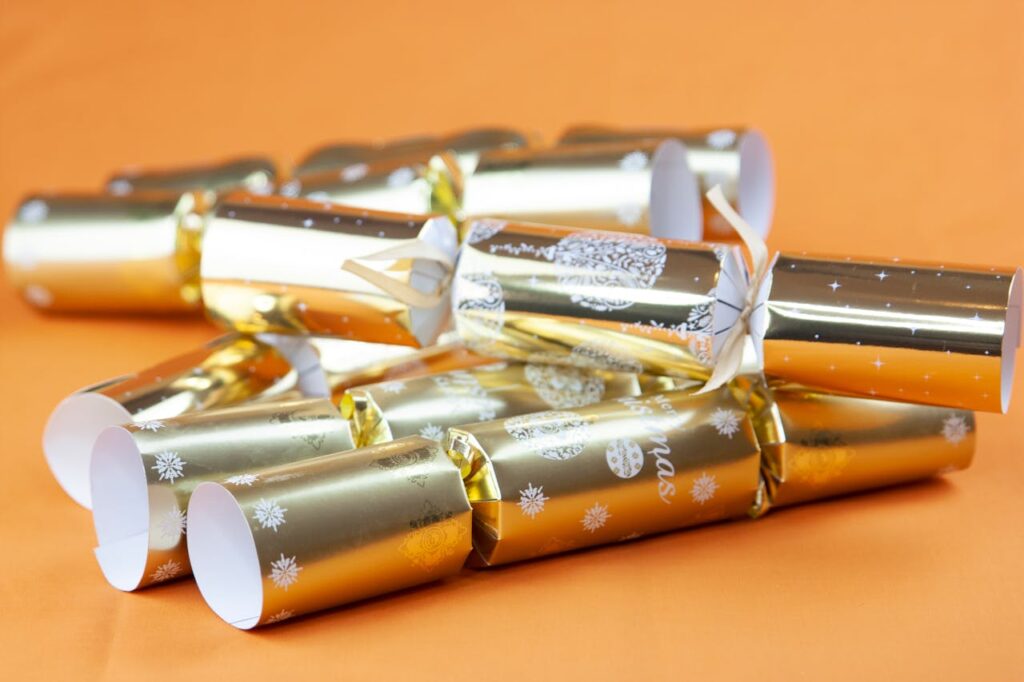
- Cross arms to pull with your neighbours at the table (avoids awkward reaching)
- The person who gets the bigger end keeps the contents (non-negotiable)
- Everyone must wear their crown for at least 5 minutes (yes, even teenagers)
- Someone must read the jokes aloud (this is compulsory suffering)
- Don’t throw away the tiny gifts immediately (even though you want to)
Breaking these rules? Basically treason.
The Great Cracker Controversies
The Noise Issue
Some people absolutely hate the bang. It startles dogs, upsets small children, and makes elderly relatives jump. But removing the bang entirely? That’s not a cracker, that’s just waste paper with delusions of grandeur.
The Waste Problem
Modern environmentalists (rightfully) point out that crackers generate loads of rubbish. Single-use plastic toys, non-recyclable hats, and packaging that can’t be properly disposed of. The industry’s slowly catching up with reusable and eco-friendly options, but we’ve got a way to go.
The Gift Disappointment
We all know the gifts are rubbish. We’ve known since childhood. Yet every year, there’s still that tiny hope that maybe, just maybe, this time you’ll get something actually useful. You won’t. It’ll be a tiny magnifying glass or a puzzle with a piece missing.
Making Your Own Christmas Crackers
Fancy having a go yourself? It’s surprisingly easy and means you can put actually good stuff inside.
You’ll need:
- Cardboard tubes (toilet roll tubes work)
- Cracker snaps (buy online)
- Wrapping paper or tissue paper
- Ribbon or string
- Gifts, jokes, and paper crowns
How to make them:
- Cut paper twice the length of your tube
- Place snap strip inside tube
- Add your gifts, joke, and crown
- Roll paper around tube
- Tie ribbon at both ends, leaving snap strips accessible
- Twist ends like a sweet wrapper
Fill them with things people actually want: lottery tickets, mini bottles of spirits, decent chocolates, or personalised gifts for each person. Your family will think you’re brilliant.
Tom Smith’s Legacy Today
The Tom Smith company that started it all still exists, though it’s changed hands over the years. They’re now part of IG Design Group and still manufacture millions of crackers annually. Not bad for something that started with a bloke staring at his fireplace.
There’s even a commemorative plaque in Finsbury Square, London, marking the site of Tom Smith’s original factory. Because if there’s one thing we British love more than Christmas crackers, it’s commemorative plaques.

The Future of Christmas Crackers
So what’s next for this peculiar tradition?
Trends for the 2020s:
- More sustainable, plastic-free options
- Reusable luxury crackers
- Personalised crackers with photos and custom gifts
- Tech gifts like USB sticks or phone accessories
- Charitable crackers where purchases support good causes
- DIY kits for making your own
But whatever changes come, one thing’s certain: British families will still be pulling crackers every Christmas, wearing wonky paper crowns, groaning at terrible jokes, and pocketing useless tiny screwdrivers.
Because that’s tradition, innit?
The Bottom Line
Christmas crackers are ridiculous. They’re wasteful, the gifts are rubbish, the jokes are painful, and the paper crowns never fit properly. But they’re also brilliant. That moment when everyone crosses arms, pulls together, and the table erupts in a series of sad little pops? That’s Christmas.
Tom Smith probably had no idea his fireplace epiphany would create something so enduringly, stubbornly British. But here we are, nearly 180 years later, still doing exactly what he invented.
So this Christmas, when you’re wearing your lopsided paper crown and reading out another groan-worthy joke, spare a thought for Tom Smith. The Victorian confectioner who heard a log crack and thought “I can make money from that.”
Genius, really.
Related: Back to UK Christmas Traditions Guide
What’s the worst Christmas cracker gift you’ve ever received? Tell us in the comments—we all need to know we’re not alone in the tiny-magnifying-glass club!