After Christmas pudding, when everyone’s claiming they’re absolutely stuffed, out comes the cheese board. And suddenly everyone’s got room for “just a bit of cheese.”
The Christmas cheeseboard has become as traditional as the turkey itself. It’s the final act of Christmas dinner, the thing that keeps people at the table chatting, and an excellent excuse to open that port you’ve been saving.
But what makes a good cheese board? How much do you need? And is there actually a science to it, or do you just chuck some cheese on a board and hope for the best?
This is your complete guide to the ultimate Christmas cheese board.
- Why Cheese After Christmas Dinner?
- The Essential Cheese Board Formula
- Christmas Cheese Choices
- How Much Cheese to Buy
- What to Serve With Cheese
- Port: The Traditional Pairing
- Presentation Tips
- Cheese Temperature
- Dietary Considerations
- Budget Cheese Board
- Luxury Cheese Board
- Timing Your Cheese Board
- Leftover Cheese
- Common Cheese Board Mistakes
- The Bottom Line

Why Cheese After Christmas Dinner?
Historical reasons: Cheese after dinner is a very British (and French) tradition. It cleanses the palate after a rich meal and pairs beautifully with port.
Practical reasons:
- Gives pudding time to settle
- Keeps people at the table
- No cooking required
- Easy to serve
- Everyone likes at least some cheese
The real reason: After stuffing ourselves with turkey, we somehow always have room for cheese. It’s a Christmas miracle.
The Essential Cheese Board Formula
The rule: Include 4-6 different cheeses covering different types.
The Classic Four
1. Hard cheese: Mature cheddar or similar
2. Soft cheese: Brie or Camembert
3. Blue cheese: Stilton (the Christmas classic)
4. Wild card: Something interesting
This combination gives variety in texture, flavour, and strength. Everyone will find at least one they like.
Expanding to Six
Add: 5. Goat’s cheese: Creamy or harder aged versions
6. Washed rind: Like Taleggio (if you’re brave—they’re stinky!)
Christmas Cheese Choices
Stilton: The Christmas King
Why it’s THE Christmas cheese:
- British (specifically from Nottinghamshire, Derbyshire, or Leicestershire)
- Strong and distinctive
- Pairs perfectly with port
- Traditional since Victorian times
- Available everywhere at Christmas
Which Stilton:
- Blue Stilton: Classic, crumbly, tangy
- White Stilton: Milder, often with cranberries or other fruits
How much: 50-75g per person
Serving: Room temperature, with the rind on (it’s edible)
Cheddar: The Reliable Anchor
Go for: Vintage or extra mature. Christmas isn’t the time for mild cheddar.
Good options:
- Barber’s 1833 Vintage
- Cathedral City Extra Mature
- Cornish Yarg (wrapped in nettles—looks impressive)
- Aged farmhouse cheddar
Why it works: Everyone knows it, everyone likes it, and it anchors the board.
Brie or Camembert: The Crowd-Pleaser
Brie: Milder, crowd-pleasing, spreadable when ripe
Camembert: Stronger, more distinctive, gooey centre
For Christmas: Consider a whole small Camembert you can bake (poke holes, add garlic and rosemary, bake until molten). Very impressive.
How to choose: Press gently—should feel soft but not liquid.
The Goat’s Cheese
Options:
- Soft and creamy (like goat’s Brie)
- Semi-hard aged versions
- Rolled in ash or herbs
Why include it: Adds tangy contrast, different flavour profile, looks elegant.
The Wild Card
Ideas:
- Wensleydale with cranberries: Very festive, slightly sweet
- Smoked cheese: Adds depth, different texture
- Red Leicester: Adds colour to the board
- German Cambozola: Blue brie—gateway blue cheese for those who usually don’t like blue
How Much Cheese to Buy
Per person as part of Christmas dinner: 75-100g total across all cheeses
For 6 people:
- 100-150g of each cheese type
- Total: 400-600g of cheese
For 10 people:
- 150-200g of each cheese type
- Total: 800-1000g of cheese
Better too much than too little. Leftover cheese is never a problem. Cheese shortage at Christmas is a disaster.
What to Serve With Cheese
Crackers
Essential. The vehicle for cheese consumption.
Good options:
- Water biscuits (neutral, lets the cheese shine)
- Oat cakes (sturdy, slightly sweet)
- Carr’s Table Water Crackers (classic)
- Rosemary crackers (festive)
- Seeded crackers (texture and flavour)
How many: More than you think. Probably double that. People eat loads of crackers.
Fruit
Fresh:
- Grapes (red and green for colour)
- Apple slices (stop them browning with lemon juice)
- Pear slices
- Figs (if you’re fancy)
Dried:
- Apricots (pair brilliantly with blue cheese)
- Figs
- Dates
Why fruit: Sweetness cuts through rich cheese, cleanses palate, looks pretty.
Accompaniments
Essentials:
- Celery (traditional with Stilton)
- Pickled onions or cornichons
- Chutney (red onion, fig, or apple)
- Membrillo (quince paste—posh but worth it)
Optional extras:
- Olives
- Nuts (walnuts pair with blue cheese)
- Honey (drizzle over Brie)
- Fresh fig jam
Bread
Some people prefer bread to crackers:
- Baguette slices
- Sourdough
- Walnut bread (excellent with blue cheese)
- Crackers AND bread (cover all bases)
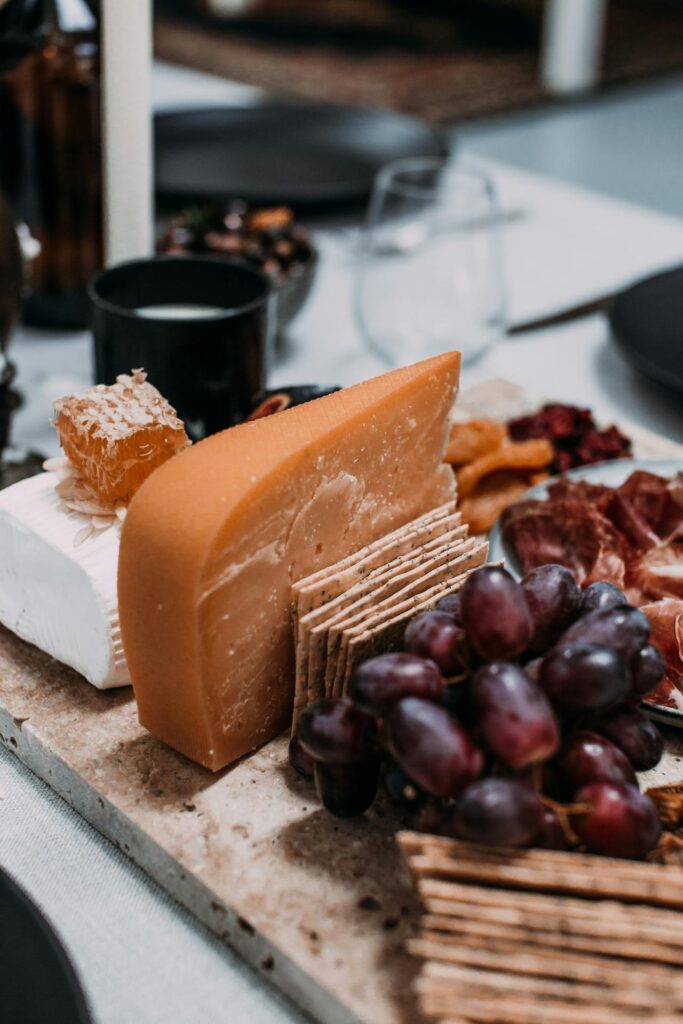
Port: The Traditional Pairing
Why port with cheese: Port is sweet and rich, contrasts beautifully with salty, tangy cheese. Stilton and port is the classic combination.
Types of port:
- Ruby port: Fruity, affordable, perfect for cheese
- Tawny port: Nutty, aged, more complex
- Vintage port: Expensive, special occasion, decadent
How much: One bottle for 6-8 people (assuming other drinks available)
Other wine options:
- Red wine (full-bodied works best)
- Sweet wine (Sauternes with blue cheese is incredible)
- Sherry (particularly with hard cheeses)
Presentation Tips
The board itself:
- Wooden board (classic)
- Slate (looks fancy)
- Marble (keeps cheese cool)
- Large plate (if that’s what you’ve got)
Arrangement:
- Space cheeses out—don’t crowd
- Add height variation
- Group accompaniments around cheeses
- Leave room for people to cut and serve
Knives:
- One knife per cheese (prevents flavour mixing)
- Small knives for spreading soft cheese
- Proper cheese knife for hard cheese
Labelling:
- Use little cards or flags
- Note cheese names
- Helpful for guests
- Looks posh
Garnish:
- Fresh herbs (rosemary, thyme)
- Fresh grapes still on the vine
- Nuts scattered around
- Make it look abundant and generous
Cheese Temperature
The rule: Cheese should be served at room temperature.
Why: Cold cheese has a muted flavour. Room temperature cheese tastes better.
How long to leave out: 30-60 minutes before serving.
Exception: Hot days (rare at Christmas in Britain, but still). Don’t leave cheese out for hours in a warm room.
Dietary Considerations
Vegetarian: Many cheeses use animal rennet. Check labels for vegetarian-friendly versions.
Vegan: Plant-based cheese alternatives exist now. Quality varies wildly. Try before serving.
Lactose intolerant: Hard, aged cheeses (like mature cheddar) have very little lactose. Many people who struggle with milk can eat them fine.
Pregnant: Avoid unpasteurised cheese and blue cheese. Stick to hard, pasteurised varieties.
Budget Cheese Board
Under £20 for 6 people:
- Mature cheddar from supermarket (£3-4)
- Brie or Camembert (£3-4)
- Small Stilton (£4-5)
- Goat’s cheese (£3-4)
- Basic crackers, grapes, chutney (£5)
Total: £18-22
Still impressive, still delicious, won’t break the bank.
Where to save:
- Supermarket own-brand cheese (often excellent)
- Skip exotic additions
- Basic crackers are fine
- Seasonal fruit is cheap
Where not to save:
- Stilton (get decent Stilton, it’s the star)
- Enough crackers (running out is embarrassing)
Luxury Cheese Board
£60+ for 6 people:
- Aged farmhouse cheddar (£8-10)
- Whole Camembert for baking (£6-8)
- Artisan goat’s cheese (£6-8)
- Interesting washed rind or unusual cheese (£8-10)
- Luxury crackers, membrillo, fig jam, quality chutney, fresh figs (£12-15)
Total: £60-70
Special occasion worthy, will impress guests, tastes significantly better.
Timing Your Cheese Board
When to serve:
- After Christmas pudding
- Let the pudding settle for 15-20 mins
- Bring out the cheese board
- Refill wine/port glasses
- Settle in for the second round of eating
How long people linger: Usually 45-60 minutes. The cheeseboard keeps people at the table chatting. That’s part of its charm.
Leftover Cheese
Storage:
- Wrap each cheese separately
- Use wax paper or cheese paper (better than cling film)
- Store in the fridge
- Use within a week
What to do with leftovers:
- Cheese toasties
- Cauliflower cheese
- Pasta bakes
- Cheese sauce
- Just snacking (honestly, the best option)
Common Cheese Board Mistakes
Too little variety: All mild cheeses or all strong—mix it up
Not enough crackers: Always buy more than you think
Forgetting knives: One per cheese minimum
Serving cold: Room temperature is crucial
Too much blue cheese: Many people don’t like it—don’t let it dominate
Cheap Stilton: This is the one to invest in—it’s the star
The Bottom Line
The Christmas cheese board is one of those traditions that’s got better over time. What used to be a bit of cheddar and some crackers has evolved into a proper course that people genuinely look forward to.
The key is variety—something for everyone, from the blue cheese lovers to the people who just want cheddar. Add some decent accompaniments, serve at room temperature, and pour the port.
Then sit back and watch as everyone who claimed they were “absolutely stuffed” somehow manages to eat loads of cheese.
Because that’s Christmas. Room is always found for cheese.
Related Guides:
- Back to Complete Christmas Food Guide
- Traditional British Christmas Dinner Guide
- Christmas Pudding: History & Recipes
What’s your essential Christmas cheese? Are you Team Stilton or do you prefer something else? Share your cheese board tips in the comments!